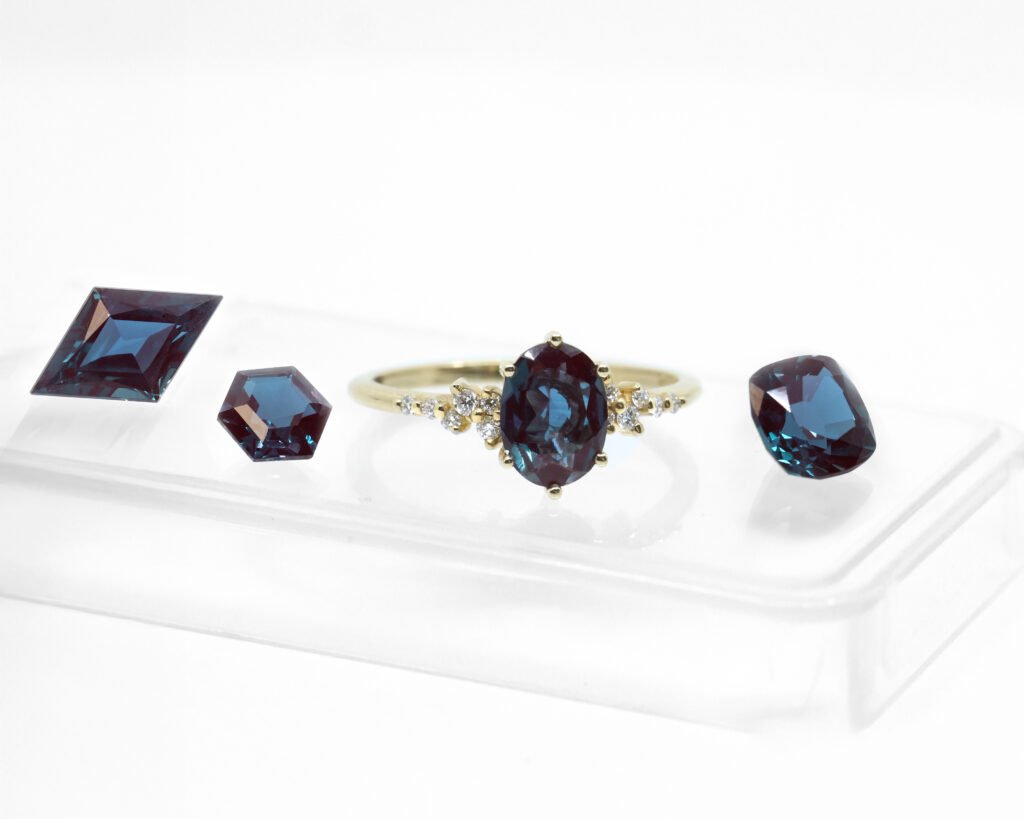

For decades, the classic engagement ring formula was easy to recognize: one diamond, centered on a gold or platinum band.
But not everyone wants their engagement ring to look familiar.
There is nothing wrong with that design. The solitaire remains popular precisely because it is simple and puts the gemstone at the center of attention.
Today, a unique engagement ring is better defined by intentional design choices that move beyond standard combinations of stone, setting, shape, color, and proportion. That might mean an unusual gemstone, an asymmetrical setting, a colored center stone, unexpected side stones, a nature-inspired band, or a completely custom composition.
Importantly, “unique” doesn’t have to mean extravagant.
Sometimes one unexpected detail is enough.
What Is a Unique Engagement Ring?
A unique engagement ring is a ring that uses one or more distinctive design elements to create a look outside conventional engagement-ring styles.
Those elements can include:
- An unusual center gemstone
- A non-traditional gemstone shape
- Colored or contrasting stones
- Asymmetrical composition
- Unconventional stone placement
- Nature-inspired details
- Mixed gemstone cuts
- Alternative settings
- Distinctive metalwork
- Custom or bespoke design
A ring doesn’t need all of these characteristics to feel individual.
The key is how its different elements work together.
1. Start With an Unexpected Center Stone
One of the easiest ways to move beyond a traditional solitaire is to reconsider the center gemstone.
Diamonds remain an important engagement-ring choice, but they are far from the only option.
Sapphires can introduce blue, teal, green, peach, pink, or other colors. Moss agate contains natural inclusions that can resemble miniature landscapes. Tourmaline appears in an exceptionally broad color range, while alexandrite is known for changing appearance under different lighting conditions.
Even diamonds can look unconventional.
Salt-and-pepper diamonds deliberately celebrate visible inclusions rather than trying to eliminate them, while champagne, gray, and other colored diamonds create a very different effect from a conventional colorless stone.
Choosing the center gemstone can therefore establish the entire personality of the ring.
2. Gemstone Shape Can Change Everything
Two rings using the same gemstone can look completely different simply because of shape.
Round stones tend to create a familiar, balanced appearance.
But engagement rings can also use:
Oval, pear, marquise, emerald, cushion, radiant, kite, hexagon, trillion and other geometric cuts.
Elongated stones can visually lengthen the finger. Angular cuts can create a more architectural appearance. Kite and hexagonal gemstones immediately introduce geometry that is less commonly associated with traditional bridal jewelry.
Orientation matters too.
An oval or emerald-cut stone doesn’t always need to sit vertically. Turning it horizontally creates an east-west setting and can transform a familiar gemstone into a much less conventional design.
3. Use Color as Part of the Design
Traditional engagement rings often rely on a colorless diamond and neutral precious metal.
Adding color changes the visual language immediately.
A sapphire center stone surrounded by diamonds creates one effect. A green tourmaline paired with warm yellow gold creates another. A moss agate with small green and colorless accents can produce an organic composition.
Color doesn’t necessarily need to come from the center stone.
Small accent gemstones can introduce subtle color while keeping a diamond as the focal point.
This gives designers considerable freedom to make a ring distinctive without making it visually overwhelming.
4. Move Beyond Perfect Symmetry
Traditional jewelry often relies heavily on symmetry.
The center stone sits precisely in the middle, while matching accent stones appear on both sides.
Asymmetry provides another option.
A cluster of stones might appear predominantly on one side. Accent stones can use different shapes. A curved band might wrap around the center gemstone instead of mirroring itself.
This type of composition can make the ring feel more organic and less standardized.
It also works particularly well with nature-inspired jewelry, where perfect symmetry isn’t always necessary.
5. Mix Different Gemstone Shapes
A ring doesn’t need to use the same cut for every stone.
Combining gemstone shapes can create movement and visual contrast.
For example:
- Oval center + pear side stones
- Hexagon center + round diamonds
- Kite center + marquise accents
- Emerald cut + baguette side stones
- Pear center + small round and marquise stones
This technique is particularly effective in cluster and three-stone designs.
Rather than thinking about each gemstone separately, the designer treats the stones as parts of one composition.
6. Let Nature Influence the Setting
Nature-inspired engagement rings provide another route beyond traditional bridal design.
Leaves, branches, flowers, vines, stars, and other organic forms can influence both the setting and the band.
The references don’t have to be literal.
A band might curve slightly like a branch. Marquise gemstones can suggest leaves without actually reproducing them. Small diamonds can be positioned irregularly to resemble scattered points of light.
These subtle references often create a more wearable result than directly copying natural objects.
7. Make the Setting Part of the Design
The setting isn’t only a technical structure that holds the gemstone.
It can become a major visual element.
Prong, bezel, halo, cluster, cathedral, tension-inspired, and other setting styles affect how much metal is visible, how high the gemstone sits, and how the ring looks from different angles.
According to the Gemological Institute of America, setting choice can also affect gemstone security, visibility and practical wear. Their guide to engagement ring settings provides a useful professional overview of common setting structures.
A distinctive setting can therefore make a familiar gemstone feel completely different.
8. Think About the Ring From Every Angle
Engagement rings are three-dimensional objects.
Yet people often choose them by looking only at the top view.
The side profile can contain some of the most interesting design details.
A gallery beneath the center stone can include decorative metalwork. The shoulders of the band can curve toward the gemstone. Hidden accent stones can be placed where they are visible mainly to the wearer.
These details may not dominate the ring from a distance, but they can make the design feel personal when viewed up close.
9. Consider a Cluster Instead of One Dominant Stone
A traditional engagement ring typically establishes a clear hierarchy:
one large center stone + smaller supporting stones.
A cluster design can challenge that structure.
Several gemstones can work together to form the central composition, sometimes using different shapes, colors, or sizes.
This creates more freedom for asymmetry and unusual silhouettes.
It can also make the ring visually substantial without requiring one very large center gemstone.
10. Customization Can Make an Existing Design Unique
A ring doesn’t necessarily need to be designed completely from scratch.
An existing design can become the foundation for something personal.
Changing the center gemstone, metal, accent stones, gemstone orientation, proportions, or band can substantially alter its appearance.
For buyers exploring a unique engagement ring, this distinction matters because individuality can come from both original designs and thoughtful customization of an existing style.
The goal isn’t necessarily to create something nobody has ever imagined before.
It is to create something that feels specific to the person wearing it.
Does Unique Mean Trendy?
Not necessarily.
A trend is something that becomes popular across many people at roughly the same time.
A unique design is based on individual choices.
The two can overlap, but they aren’t the same.
For example, oval diamonds may become fashionable while still being used in highly individual designs. Similarly, colored gemstones can trend while individual combinations of stone, setting, and metal remain highly personal.
This is why choosing an unusual ring purely because it is currently popular can miss the point.
The design should still make sense years after the trend has passed.
Does a Unique Engagement Ring Have to Be Expensive?
No.
Uniqueness doesn’t come directly from price.
A rare gemstone or highly complex custom setting can certainly increase cost, but relatively simple changes can also make a ring distinctive.
A smaller sapphire in an unusual cut, an east-west gemstone orientation, an asymmetrical accent arrangement, or a simple bezel setting can create individuality without requiring an exceptionally large budget.
Design decisions often have more influence on uniqueness than carat weight.
How Do You Choose a Unique Engagement Ring?
Start with the wearer rather than the ring.
Ask:
What jewelry do they already wear?
Do they prefer color or neutral tones?
Do they like clean geometry or organic shapes?
Would they prefer one dominant gemstone or several smaller stones?
Do they gravitate toward modern, vintage, minimal, botanical, or unconventional designs?
Then consider practical factors.
A highly raised setting may not suit someone who works frequently with their hands. Delicate clusters contain more settings that may require periodic inspection. Certain gemstones also require more careful everyday wear than diamonds or sapphires.
A successful design needs to be both visually interesting and practical for the person wearing it.
Unique vs. Unusual: There Is a Difference
An engagement ring doesn’t need to be strange to be unique.
This distinction is important.
Adding every possible design feature—multiple colors, unusual shapes, asymmetry, engraving, clusters, and elaborate metalwork—doesn’t automatically produce a better ring.
Often the strongest designs have one or two distinctive ideas.
A classic solitaire with an unusual gemstone can be unique.
A conventional diamond with an unexpected setting can be unique.
A simple three-stone ring using contrasting gemstone shapes can be unique.
Individuality comes from intentional choices, not complexity for its own sake.
Frequently Asked Questions
What makes an engagement ring unique?
A unique engagement ring uses distinctive choices in gemstone, shape, setting, color, composition, metalwork, or customization to create a design that differs from conventional bridal jewelry.
What gemstones can make an engagement ring more unusual?
Sapphires, moss agate, alexandrite, tourmaline, emeralds, opals, salt-and-pepper diamonds, and colored diamonds can all create alternatives to a traditional colorless-diamond center stone.
Can a diamond engagement ring still be unique?
Yes. Diamond rings can become distinctive through unusual cuts, east-west settings, asymmetrical arrangements, mixed gemstone shapes, colored accent stones, unconventional bands, or custom metalwork.
Are unique engagement rings always custom made?
No. A ring can have an unusual existing design, be customized from an existing model, or be created completely from scratch.
Are non-traditional engagement rings practical for everyday wear?
They can be, but practicality depends on gemstone durability, setting height, stone security, band construction, and the wearer’s lifestyle. These factors should be considered alongside appearance.
Can a solitaire engagement ring be unique?
Absolutely. A solitaire can become distinctive through an unusual gemstone, cut, orientation, metal, setting, band shape, or side-profile detail while retaining the simplicity of a single center stone.
Final Thoughts
A unique engagement ring isn’t defined by one particular gemstone or setting.
It is created through design choices.
An unexpected gemstone introduces color or natural variation. An unusual cut changes the silhouette. Asymmetry introduces movement. Mixed stone shapes create contrast. Nature-inspired details add organic forms, while customization allows those elements to become personal.
And sometimes the most effective design is surprisingly simple.
Instead of asking, “How unusual can we make this ring?”, a better question is:
“Which details would make this ring feel like it belongs specifically to the person who will wear it?”
That is where a genuinely unique engagement ring begins.